January Tunes - 2026
A retreat march, and two dance tunes this month.

In Memory of Frank G. Stewart (1951-2025) (Click on Frank’s name for a link to his obituary.)
Click here for an audio recording of the tune
This from David MacAdam in response to my request for his permission to play his 4/4 march as a 3/4 retreat march at his memorial service…..
“When I sat down to compose "Mr. Frank Stewart of Hudson" I first had in mind a retreat march. On further reflection I wished something uplifting that did not sound funerary. Frank was still with us at that point, and would hear the march played on two separate occasions. I feared a retreat march might sound as if I was writing for his demise. So I revised what I had written into a 4/4 march. But as you see I didn't do a good job of hiding its 3/4 retreat march origins.
Now that Frank has left us, I think it's appropriate to return my 4/4 into what it really wants to be - the 3/4 retreat march I originally envisioned, and that you have arranged for his memorial.
Your shifting of "the bar lines to provide strong emphasis for fiddlers" makes a lot of sense. Being as it is a Scottish march I understand the dots / tails being played longer / shorter than written. Going forward I will circulate and promote the piece as a 3/4 retreat march, and you should too.”
The Boys of the Mhairi L (audio)
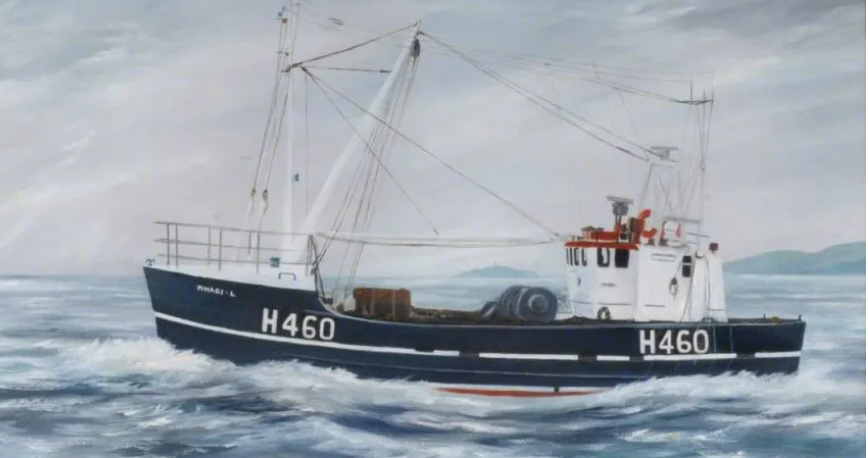
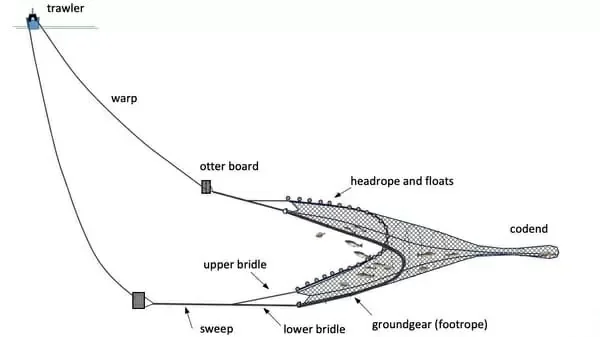
Composed by accordionist Ewan McGowan (1945-2015) as a slow air in memory of the Kirkcudbright-based fishing boat the Mhari L (sic) which sank in February 1985 with the loss of all 5 crew. While trawling for scallops in the Irish Sea off the Isle of Man she suddenly disappeared. Ewan was friends with some of the crew.
At the time there were conspiracy theories about submarines on NATO war exercises getting entangled in trawler cables and dragging boats down, or trawl nets getting fouled in undersea communication cables.
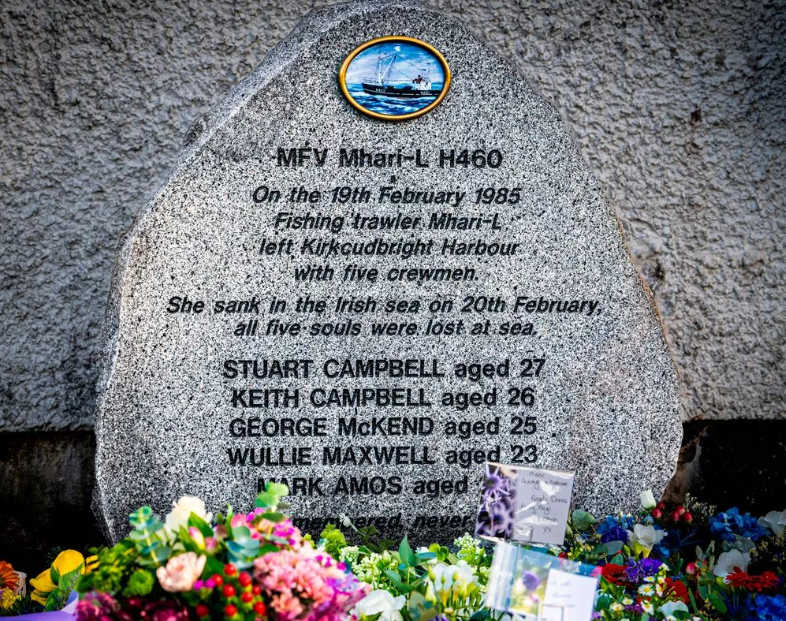
Now, 40 years later, a memorial has been installed, and the tune plays nicely as a waltz.
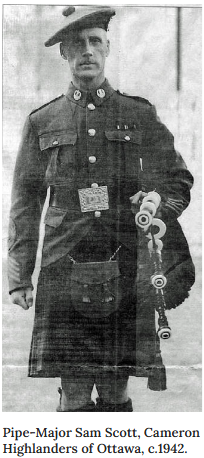
Pipe Major Sam Scott (1905-1972) (audio)
Samuel Scott was born in Glasgow on October 6, 1905. His mother and father, Margaret MacLean Paul and William Scott of Glasgow, sailed for Canada two years later and settled in the Ottawa Valley. By the time Samuel was eight years old, he was taking bagpipe lessons and learning Gaelic mouth music from Pipe-Major Tait through the St. Andrew’s Society in Ottawa. In 1920, he enlisted with the Non-Permanent Active Militia, joining the Cameron Highlanders of Ottawa (Machine Gun).
When Germany invaded Poland in September of 1939, Samuel was among the first senior noncommissioned officers of the Camerons to volunteer to fight for Canada as part of the 4th Canadian Infantry Brigade with the Royal Regiment of Canada, the Royal Hamilton Light Infantry and the Essex Scottish. By September 15, 1939, the Camerons’ Pipe-Major was Samuel Scott, who went to war at the remarkable age of thirty-four.
He saw action in WW2 for 5 years. Scott was one of few pipers to play on the Normandy beaches on D-Day, piping troops ashore in 1944.He also served as a machine-gunner and a stretcher-bearer. Prior to his war service he spent some time in the Highlanders’ Club Glasgow where he made lifelong friends with Pipe Major Peter R. MacLeod of Lewis who penned this classic 6/8 march.