December Tunes - 2025
This month Mari Black brings us a rather unusual type of set: consisting of a slow strathspey and a pair of jigs; one a traditional Scottish jig, and the other by a contemporary Irish piper/harpist. The notation can be found in “Events” or in the “December” button in the Tune Library. Listen to the tunes by clicking the name below for the audio file.
Just the Facts:
The strathspey Miss Mariane Oliphant (Rossie’s) and the jig Mrs Oswald (of Auchincruive's) Favourite Reel*, both in G major, are compositions by Robert Mackintosh from late 18th century Scotland, published in his 1793 (2nd) Collection .
*Mackintosh persistently called his jigs “Reels”. Who knows why?
The second jig, Lisnagun is a pentatonic D modal composition by Brendan Ring, a contemporary Irish multi-instrumentalist (pipes, low-whistle and wire-strung clarsach). More about him later.
A Deeper Dive into Late 18th century Scotland:
The back-stories of the Mackintosh tunes give us a glimpse into the “Golden Age of Scottish Enlightenment” that followed the failed Jacobite uprisings in 1715 and 1745.

At this time, across the pond, American colonists were smarting from the outcomes of the French and Indian War / Seven Year’s War in 1763, due to increased taxes and control on western expansion. This led to the events of 1776 which the British call “The American War of Independence”.
The painting of the 1783 Treaty of Paris is missing the British signatories - one of whom appears in one of the following tales.
The Scottish experience during this period can be highlighted by following the stories of the Oliphant and Oswald families, and some of the best known Scottish composers and a poet.
Here we go ………… Stay with me down the rabbit hole!

We begin with “Red Rob” Mackintosh, so called on account of the colour of his hair and his bad temper, was born about 1745 in Tulliemet, Perthshire, and died 1807 in London.
He settled in Edinburgh around 1773, performing and teaching violin (Nathaniel Gow is believed to have been one of his students), spent three years leading a band in Aberdeen before returning to Edinburgh in 1788. He published 4 music collections, in the first one his name was spelled Macintosh. For a deeper dive click here. (hold down the Ctrl key to open a new window)
This month’s tunes are both in his 1793 2nd Collection
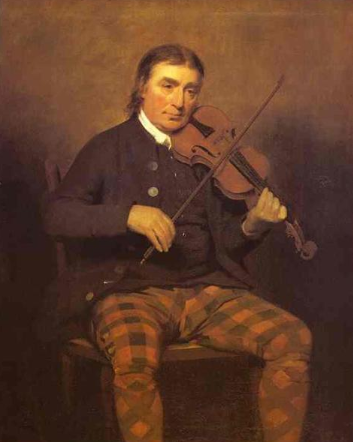
Niel Gow was born on 22nd March, 1727 at Inver, a hamlet near Dunkeld, (about 8 miles from Tullimet). Son of a plaid weaver, Niel (he always spelt his name in the Gaelic fashion) started the violin at the age of 9
In 1745, as Bonnie Prince Charlie began his ill-fated campaign, Niel won a competition in Perth open to all Scotland. Niel was patronized by three Dukes of Atholl during his long life.
A professional musician, he was much in demand to play at important balls and parties, and could command a considerable fee.
Records show that the fee of a normal fiddler of the time was about 2/6 (half a crown) to 5/- (plus a shilling of ale money). Niel’s fee was 15/-, sometimes higher, depending on the importance of the occasion. (click here for more about the old £sd system)
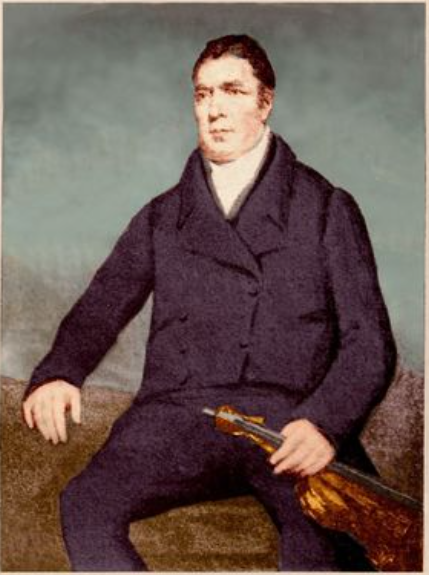
Nathaniel Gow, the fourth son of Niel Gow, was born at Inver on 28th May, 1763. Like his elder brothers William, John and Andrew, he was taught violin by his father, then sent to Edinburgh to study with Robert Mackintosh. Nathaniel inherited his father’s talents as a violinist, but with his superior education he was the better all-round musician of the two
He studied the cello and played the trumpet. In 1782 was appointed one of His Majesty’s Herald Trumpeters in Scotland. In 1791 he succeeded his brother William as the leader of the orchestra that played at the fashionable concerts in Edinburgh. Nathaniel was the leading musical figure in the capital and, like his father, was absent from few really fashionable functions. The aristocracy showered him with gifts, and George IV granted him a pension. In 1796, in partnership with William Shepherd, he started an extensive music publishing business in Edinburgh
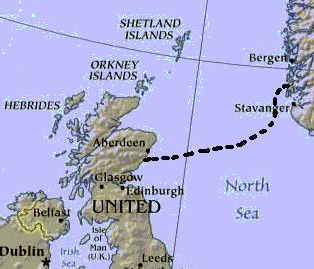
The name Oliphant came from the Norwegian name Holifard/Holifarth. The name possibly derives from the Norse name Olaf. In the 9th or 10th century Donal Holifard or Holifarth, was shipwrecked on Scotland’s east coast, near present-day Kincardineshire. (Hence the longship in the blog title)
He was well received by the King of Scotland (believed to be King Donald I) and treated with respect. He was, it seems, taken in by a local family and fell in love with their daughter. When a ship was sent from Norway to rescue him, he declined to go.
The Oliphant clan prospered and grew to have lands throughout Scotland. For an even deeper dive visit Clan Oliphant Association .
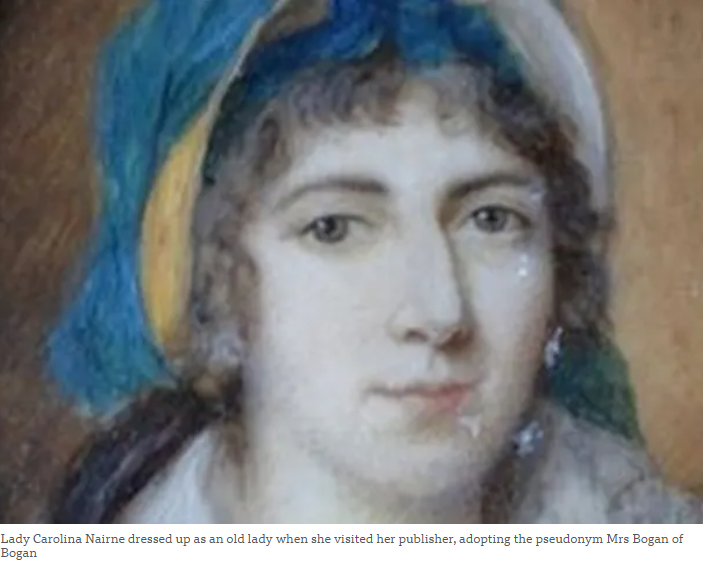
The family's history includes a renowned Scottish poetess, Carolina Oliphant (Lady Nairne), who was born in 1766 and wrote famous Jacobite songs like "Charlie is my Darling" and "Will Ye' No Come Back Again”.
She was from the Oliphant of Gask branch, a branch of the clan that were ardent supporters of Bonnie Prince Charlie and had their estate confiscated for 17 years after the failure of the 1745 Jacobite rebellion.
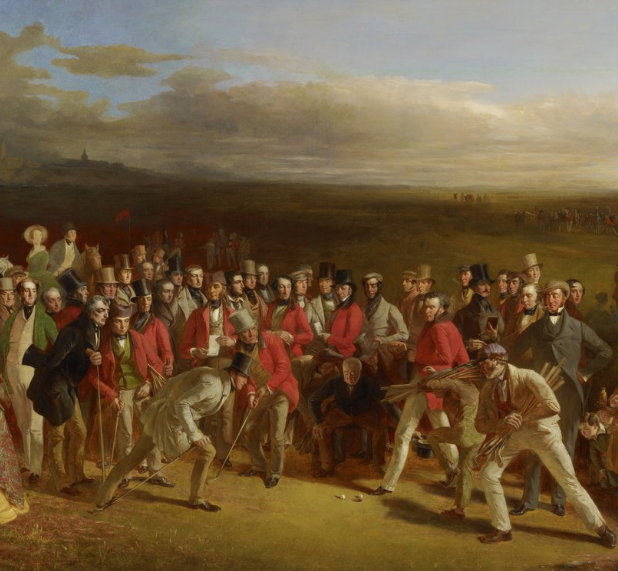
On the other hand the Oliphants of Rossie supported the monarchy and maintained possession of significant estates in Perthshire well into the 19th century, long after the principal line of the Lords Oliphant had lost most of their lands. The family was prominent in society, producing significant figures, most notably Robert Oliphant, 3rd of Rossie who was appointed the Postmaster General for Scotland in 1766, a position he held for nearly three decades until his death.
Robert was an established figure in Scottish society and appeared in Charles Lees' renowned painting "The Golfers".
The Mrs. Oswald Question
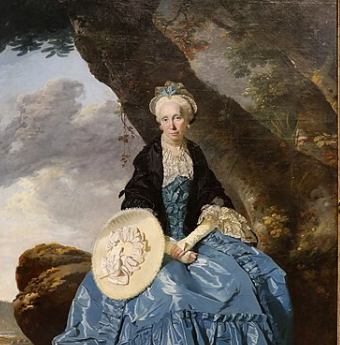
There are two possible persons who Mackintosh may have referred to in his title. The first was Mary Ramsay, the daughter of the richest Scottish planters in Jamaica, who became the wife of Richard Oswald in 1750.
Richard Oswald (1705-1784) was the son of a Caithness Kirk minister, a merchant in London, and commissioner in Paris for the peace negotiations that concluded the American War of Independence. “At least in part, United States Independence was negotiated between a British slave trader and his agent for rice growing slaves in South Carolina”
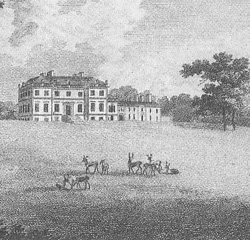
He bought the estate of Auchincruive, five miles from Ayr (along with tens of thousands of acres), in 1764, extended it, and filled it with works of art, in part with money he made from the slave trade.
Oswald owned a slave castle at Bance Island off the coast of Sierra Leone and was responsible for sending over 13,000 blacks to the southern colonies of America. The castle was "complete with a golf course serviced by tartan-clad African caddies". Later he profited from trade in the American War of Independence, earning the scorn of poet Robert Burns
Slavery was abolished in Scotland in 1778, but slave trade continued in the U.K until 1807, finally being abolished in 1833.
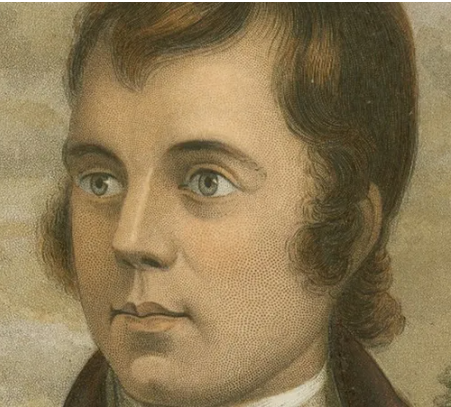
After Oswald’s death in 1784, his widow Mary remained at Auchincruive until her death in London in 1788.
She had been reviled locally for her tight-fisted ways with money. She was anathema to the poet Robert Burns (1759-96), who described her as a "venerable votary of iron avarice and sordid pride," and that she was "detested with the most heartfelt cordiality" by her tenants and servants. He called her 'the Priestess of Mammon (the God of Riches)' and wrote a scathing satire after her death in 1788
It was the arrival of her funeral cortege at the Sanquhar Inn, that deprived him of lodgings there for the night and forced him to ride on a further twelve miles on a tiring horse, himself fatigued and the weather stormy and snowing, which pushed him to write a scathing account of her life.
The lines below illustrate his feelings about her as he wrote the poem after his arduous journey. The poem suggests she is destined for hell, along with her husband
Ode, sacred to the memory of Mrs Oswald of Auchencruive
Dweller in yon dungeon dark, ‘Pity’s flood there never rose
Hangman of creation, mark! See these hands, ne’er stretch to save
Who in widow-weeds appears, Hands that took but never gave
Laden with unhonoured years, Keeper of Mammon’s iron chest
Noosing with care a bursting purse, Lo, there she goes, unpitied and unblest
Baited with many a deadly curse? She goes, but not to realms of everlasting rest!’
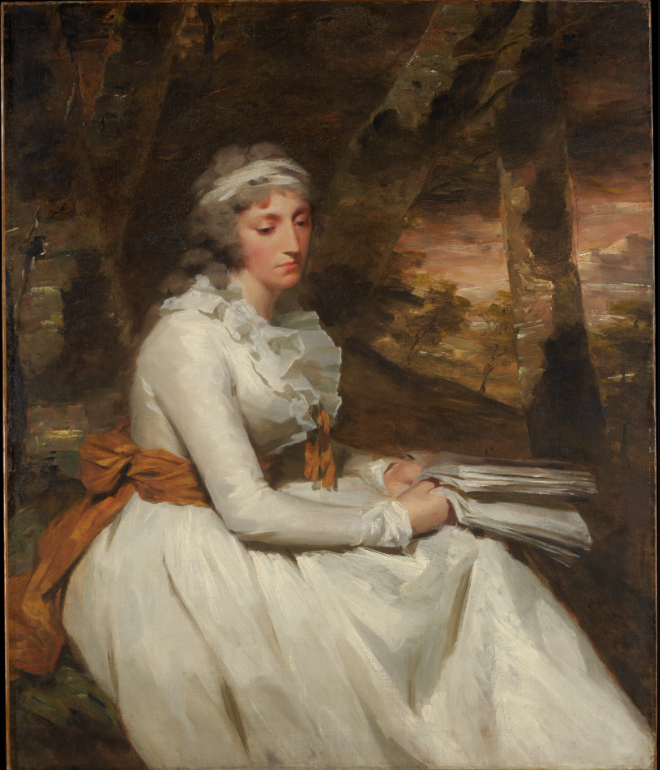
On the other hand she might have been the talented, intelligent and beautiful Miss Louisa “Lucy” Johnston of Hilton (c. 1760-1797), daughter of Wayne Johnstone of Hilton, was a distinguished amateur musician and dancer, who became Mrs. Oswald in 1793. The portrait was painted about a year after the sitter’s marriage in 1793 to Richard Alexander Oswald (1771-1841), a Member of Parliament, who inherited the estate after his mother, Mary, died in 1788.
Lucy Johnston was a composer of tunes who had some of her works published by the Gows. In praise of her beauty, Burns wrote a song, "O, Wat ye Wha’s in Yon Town." The setting sun brilliantly illuminates the sky through a screen of tree trunks and foliage, a device Raeburn favored in the mid-1790s. The subject is shown seated outdoors holding a book, lost in thought.
I know who I would prefer to think was the Mrs. Oswald in the title, but it might be that such a fine jig was all the rage in Edinburgh before 1793. Ach weel! Now on to the Irish jig…….
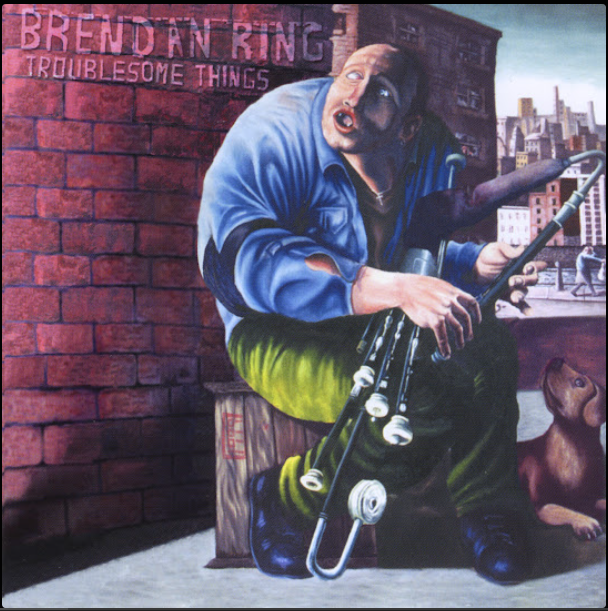
On his 2009 album “Troublesome Things” Brendan Ring records the Lisnagun jig twice, first in the opening track, then in track 8, paired with a pipe tune.
Lisnagun is an anglicisation of Lios na gCon or “Fort of the Hound”, a place located about 40 miles from Dublin on the Meath Cavan border between Carnaross and Munterconnacht.
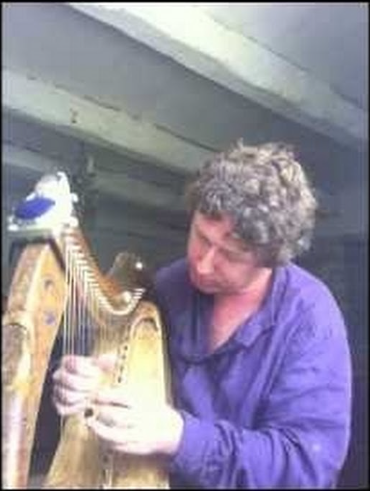
Brendan Ring is a uilleann pipes master as well as a harp player. He’s also a pipe maker and a tune composer.
Many of his tunes that he composed during the nineties are nowadays played all around the world in Irish trad sessions and are very often considered as part of the traditional repertoire. He and his wife Michelle recently moved to Ireland from central Brittany.
In his words:
I'm an Irish musician, composer and instrument maker. I play wire strung harp, uilleann pipes and low whistle. These three instruments span the entire history of Irish music. The harp was played for nearly a thousand years before that ‘new’ instrument the uilleann pipes came along. Someday, the low whistle will be old and traditional! I live in the west of Ireland with my wife the writer Michèle Vassal (Sandgames, A Taste for Hemlock). We have an unreasonable number of cats and a dog
pretending to be a bear, or possibly the other way round, we are not quite sure!
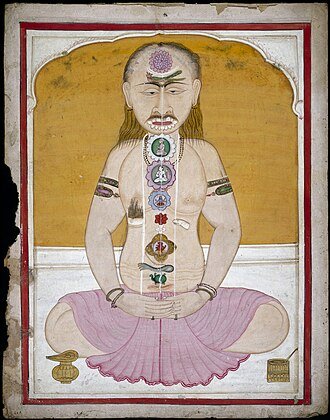
A Shamanic Kundalini Awakening is my first book. It is a personal account of an intense spiritual awakening experience that I have been undergoing for a number of years.
If you made it to the end …………Whew!! I hope I’ve given you food for thought, and I hope 2026 is a good new year for all.